Introduction
Palworld has taken the game development world by surprise. This Unreal Engine Open World + Survival + Crafting + Pokemon game managed to do something incredible: In a very short period of time it managed to sell an astounding amount of copies as well as appear everywhere on the internet.
Part of it is due to its theme and way it has used word of mouth to have a viral launch, that being said, looking only at key indicators, could we have predicted such a successful launch?
Let’s find out.
Steam Wishlists and Followers
When you are planning to launch a game on steam, before your game is live your main Key Performance Indicator is the amount of Wishlists that your game gets. More wishlists means that you are on a good track.
This happens in part because, when a game launches, Steam emails and notifies the people who have it on their wishlist ( and again later when it goes on sale, for discounts of 20% or more ). Not every wishlister gets the mail, it needs a verified email and realistically reaches somewhere around 60-75% of them, but at a big enough count that is still a large spike of traffic to your store page ( Valve documents this on the Steamworks Wishlists page ). Those launch-week sales also feed Steam’s own charts, so a big wishlist number tends to snowball into more visibility and more sales.
There is a second reason the number matters before launch: the wishlist count is itself a visibility signal. Sitting high on the Top Wishlisted list puts the game in front of more people, who wishlist it too. It is a feedback loop, which is why developers watch the number so closely.
When analyzing other games, one of the issues you can have as an indie developer is that wishlists numbers are not public, so you need to extrapolate a little bit based on other factors, the two main factors you can use are the following:
- Number of Followers: This is a public value that you can check and can correlate with wishlists on a ratio between 10-20
- Position in steam Top Wishlisted games: If you know some other game wishlist numbers you can extrapolate the number of wishlists based on a game’s position in the Top Wishlist ranking
Keep in mind the follower-to-wishlist ratio is a rule of thumb, not a law. A follow and a wishlist are different actions: a follow is a lighter signal, a wishlist is closer to actual intent to buy. The 10-20x range holds up okay on average, but the real ratio depends on how a game built its audience, so treat any number you get from it as a ballpark.
How many Steam Wishlists did Palworld have at launch?
We can not know for certain the exact number of wishlists the Unreal Engine game Palword had at Launch, but we can theorize, so let’s do just that.
First let’s see the data we have:
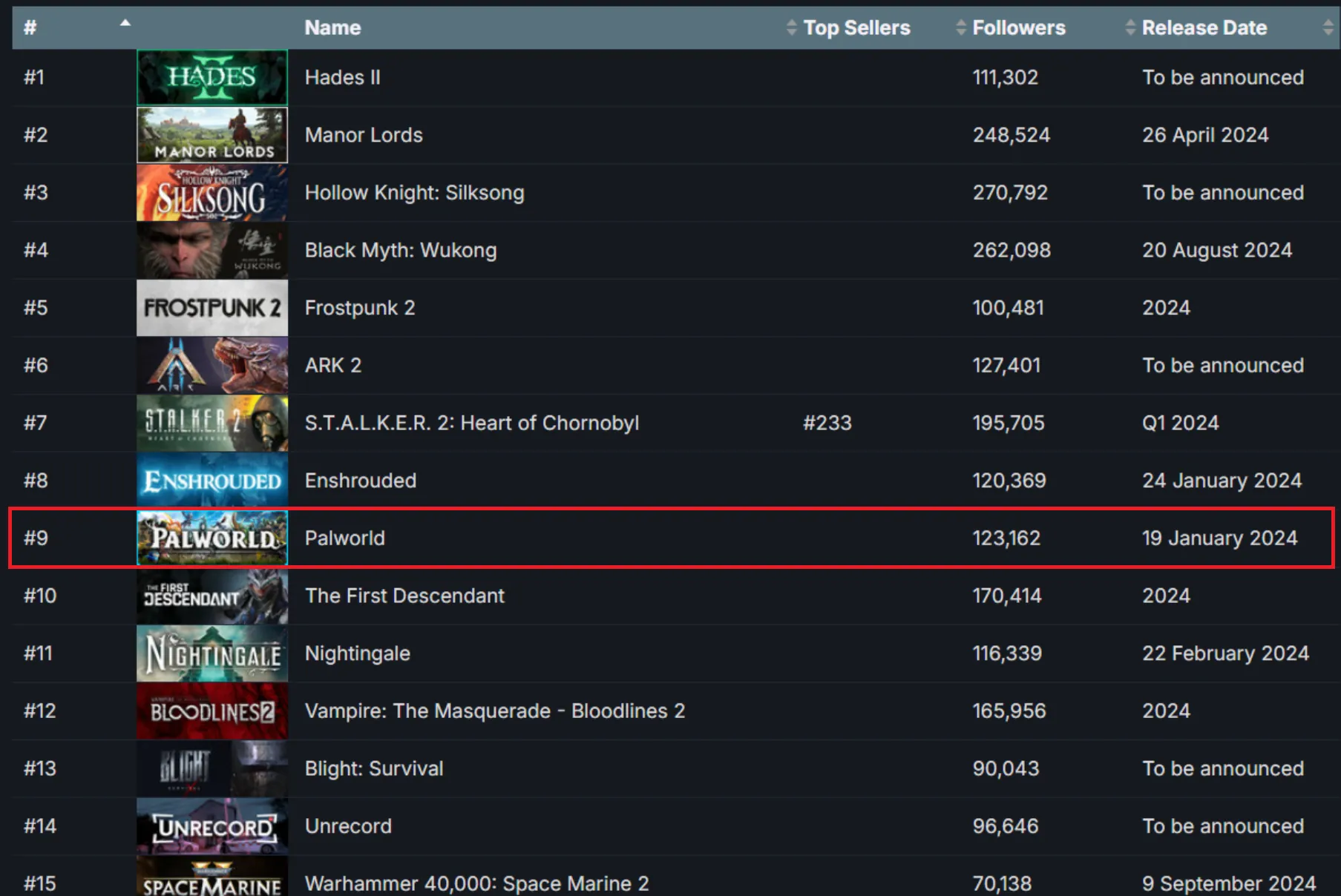
Checking historical data we can see that Palworld was the 9th most wishlisted game on steam on the 15th of January and it had 123.956 followers
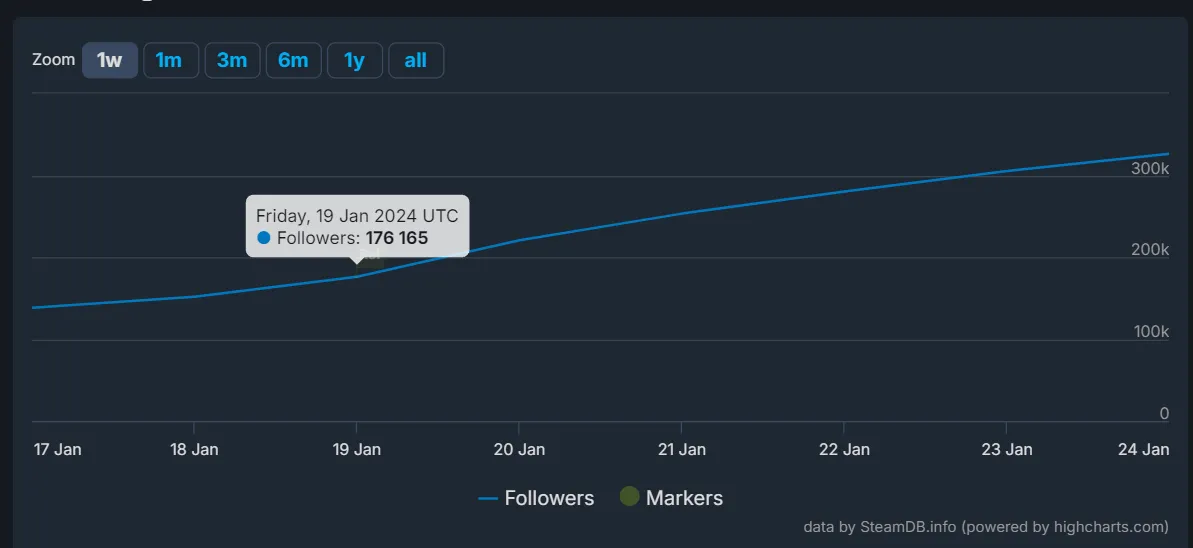
If we check SteamDB for followers data at launch we will see that Palworld had gathered 176.165 followers, so whatever we do we need to take this into account
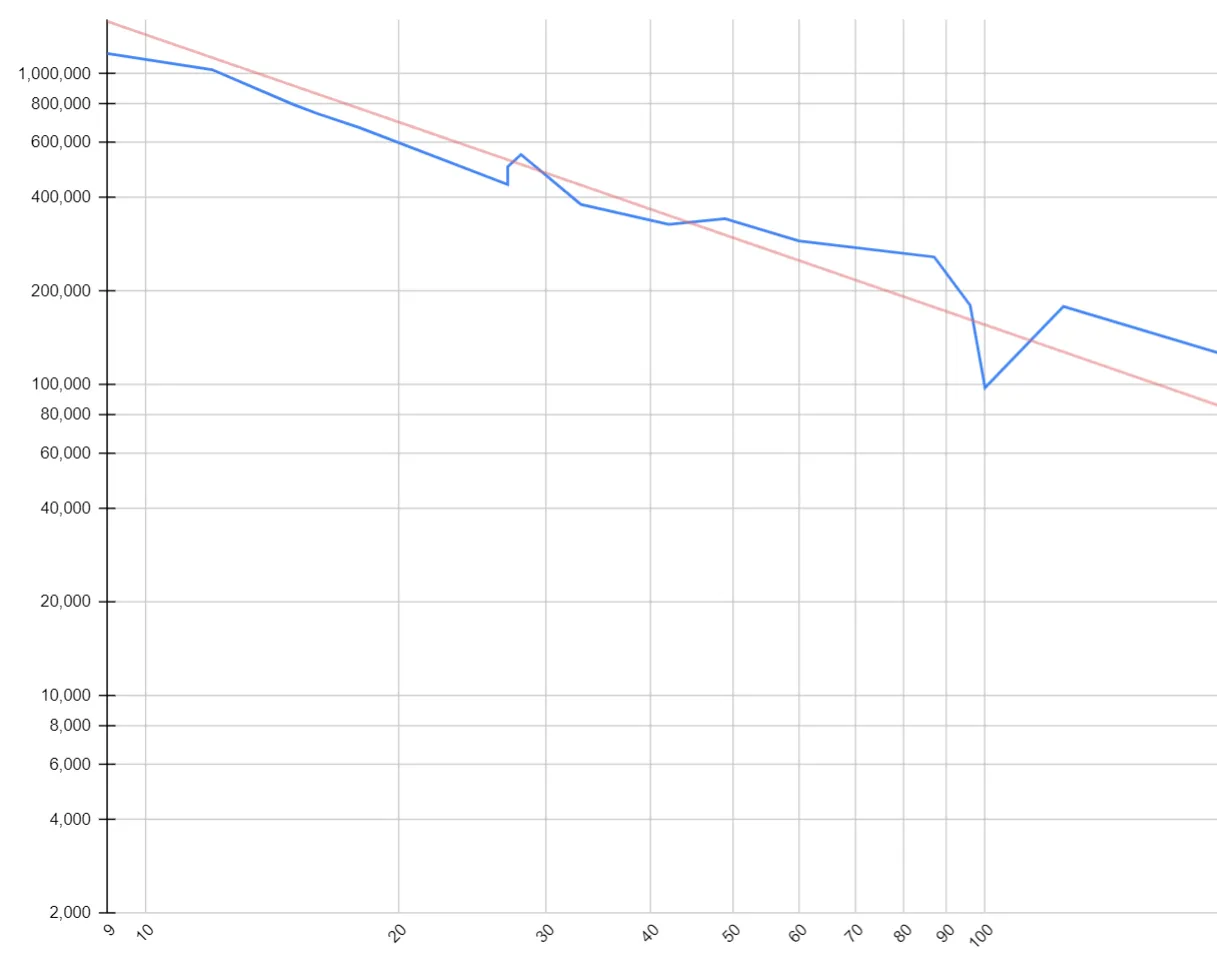
Based on my rough personal model, a game in the 9th position should have at least 1.3M of wishlists.
So with this data we can now start doing some calculations.
If we take a conservative 14x multiplier of Followers to Wishlists we would get 1.735.384 Wishlists on the 15th of January, which is in check of the value being above 1.3M for being on the 9th position.
From the 15th until launch the number of followers increased by 1.42x, so we are gonna assume Wishlists did the same, leaving us with an estimate of roughly 2.464.245 Wishlists at launch.
Of course these numbers are estimates so it would be safer to take into account the typical 10-20 follower to wishlist ratio and assume that at launch Palworld had between 1.761.165 and 3.523.300 Wishlists at launch.
So what we get from this is that Palworld had a lot of steam wishlists at launch.
Where this estimate can be wrong
Every step above rests on an assumption, and each one can move the final number by a lot:
- The follower-to-wishlist ratio is not fixed. I used 14x, then sanity-checked against 10-20x. A game that went viral on a single trailer can pull in followers without the matching wishlists, or the other way around.
- The rank-to-wishlist model is anchored on guesses. Extrapolating from the 9th spot on the Top Wishlisted list only works if you have a reliable wishlist count for another game at a known rank. The curve is steep, so a small error in the anchor becomes a big error near the top.
- Followers are not all real buyers. The public follower count includes inactive and bot accounts, so it slightly overstates genuine interest.
- Wishlists predict the launch window, not the whole run. Conversion from wishlist to sale in the first weeks varies with price, region and timing, and it says nothing about the word-of-mouth wave that came after Palworld launched.
None of this makes the exercise useless. It just means the honest output is a wide range, which is why I gave one ( roughly 1.7M to 3.5M ) instead of a single confident figure.
Analyzing Palworld Launch Success
Seeing these numbers, we could perfectly expect Palworld to sell at least 1M copies on the first month. But as we all know, that is not what happened. It sold more.
Seems that the true marketing success of Palworld did not come with the marketing that happened before the launch, but with all the virality and word of mouth that spread after the launch.
Combining all the streamers playing it, people recommending it to each other and the multiple controversies it generated due to it’s character designs, it seems that Palworld presence has spread like fire.
If we look at the number of players, it continues to rise instead of having the typical initial peak and falloff that other games can have.
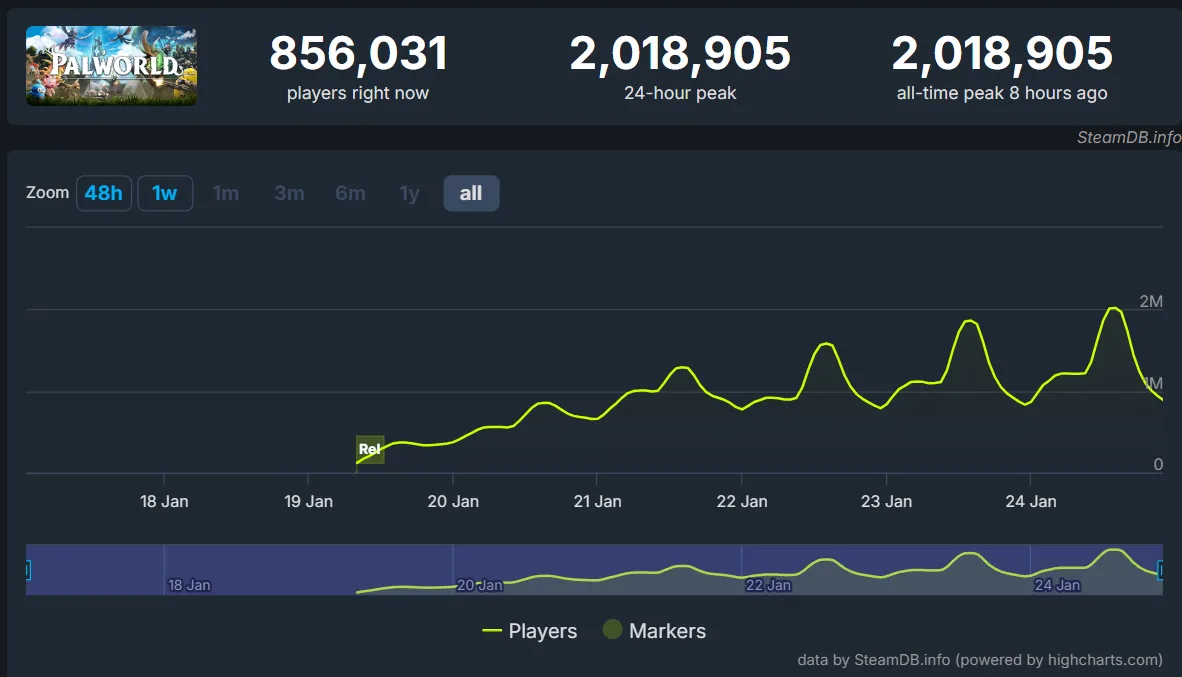
At the same time, this Unreal Engine game seems to prove once again that if you are an indie developer you should treat your early access release like if it were your actual launch, as that is exactly what it is in reality.
As of the writing of this article, Palworld has already surpassed 7 million sales, and it seems it will continue to sell more, especially if we take a look at the growth of its followers.
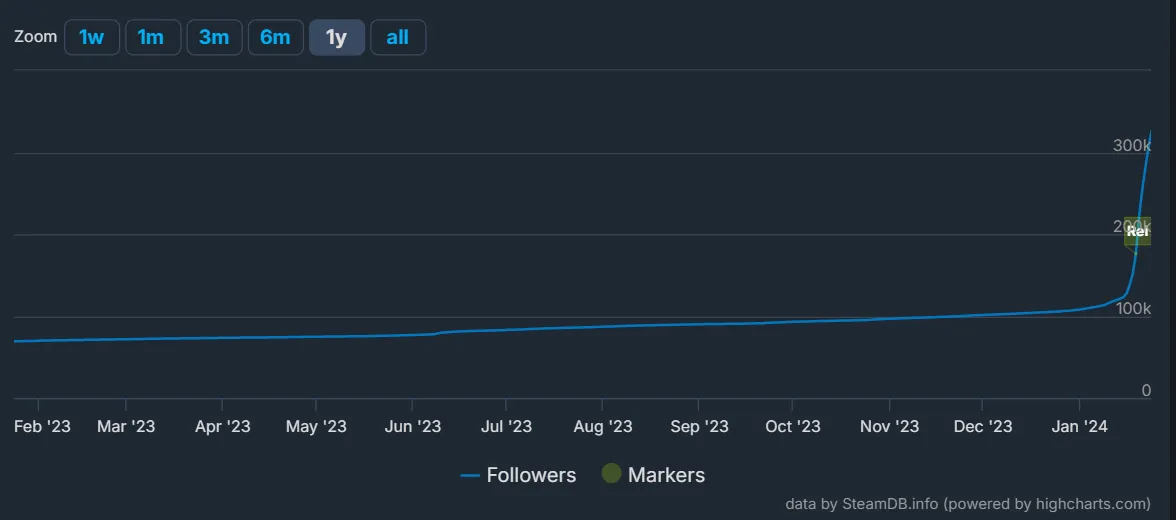
So what can indie developers take from this? The lesson that’s hardest to swallow: players seem to value how a game feels to play over the polish a developer thinks should sell it. Markets don’t always reward what you believe you built, and you don’t really find out either way until the game is out and people are actually playing it.
Recap
- Wishlists matter because Steam notifies wishlisters at launch, which front-loads sales into launch week and feeds the store’s own visibility. That is the mechanism behind “wishlists predict the launch”.
- The follower-to-wishlist ratio ( roughly 10-20x ) is a heuristic, not a fact. My launch estimate of about 1.7M to 3.5M wishlists is a range for that reason, not a single number.
- Palworld’s real story happened after launch, through streamers, word of mouth and controversy. No pre-launch wishlist model captures that, which is the whole point of the piece.
What this doesn’t cover
Every figure here is my own estimate built on public follower data and a rough model, not Valve’s internal numbers, which are not public. I also stayed on the wishlist-to-sales question and did not get into retention, refund rate, or how a viral Early Access run converts into a full release.